The Image After Epstein
and I'm not talking about Jean Epstein

In August 2019, a “leaked” photograph of Ghislaine Maxwell began to circulate online, showing her seated at an In-N-Out Burger in the San Fernando Valley (Figure 1). The photograph — initially rumored to be a candid shot captured by an anonymous diner — shows Ghislaine tending to a book, assuming the pose of “The Thinker,” a half eaten burger sitting off to her side. The photograph was taken on a Monday afternoon. Just two days prior, her partner — convicted sex offender Jeffrey Epstein — was found dead in his jail cell at the Metropolitan Correctional Center in New York. Given the extraordinary attention that now befell Maxwell and her alleged crimes, the effortless composure of the photograph was cause for widespread pandemonium.
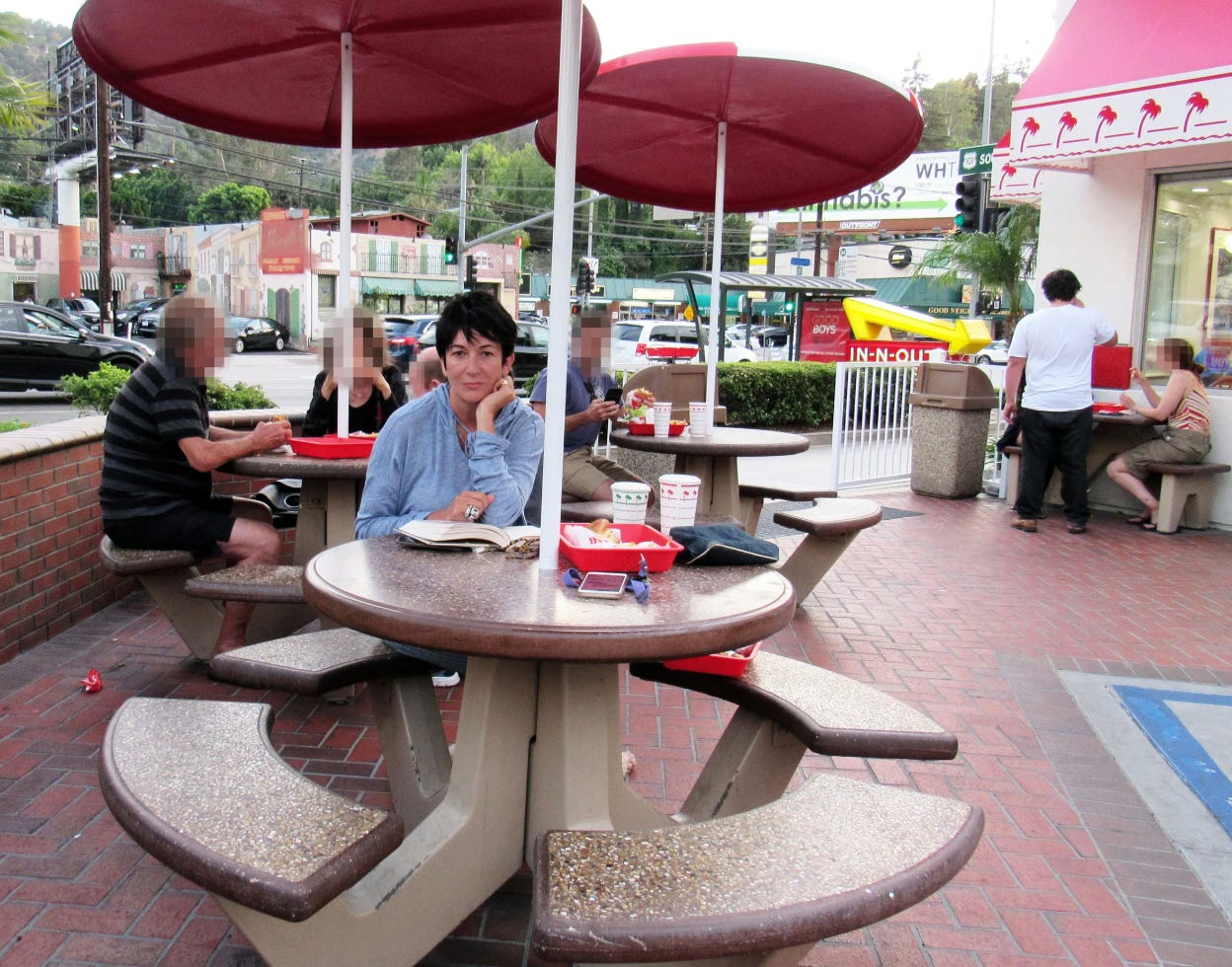
Figure 1. Animal Style
Three days following the photo’s release, a Daily Mail investigation suspected that the photo was not, in fact, taken by a random diner, but rather Maxwell’s attorney — evidence, as many were quick to assert, of Ghislaine’s insidious control of her public image. Reading a book titled “The Book of Honor: The Secret Lives and Deaths of C.I.A. Operatives” it seemed as though Ghislaine knew very well she was at the center of this decade’s most salacious scandal, toying with the limits of her legibility. As New Yorker columnist Naomi Fry wrote, “there appeared to be a distinct possibility that Maxwell was fucking with us […] it seemed to me as if she were self-consciously leaving a trail of signifiers to be close-read, only to have their sum total stop, maddeningly, just shy of meaning.”
Figure 2. Outtakes
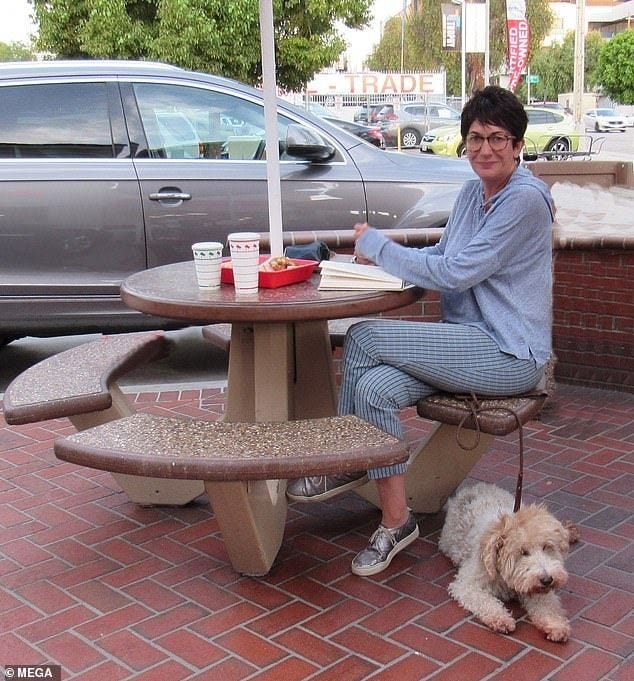
The viewer is thus presented with a choice: to accept the evidence of Ghislaine’s impromptu lunch, or to buy into the self-mythology plot: her book becoming a clue by which we can sniff out her pernicious media masterminding. The book operates as a sign — not only of Ghislaine’s desire to read — but also of her desire to be read, as if to elevate her crimes into a novelistic plot. Far more interesting than the actual provenance of the photograph, this paper is concerned with the peculiar role that the American literary imagination has played in both the Epstein files and their broader interpretations. Why, in short, are we inclined to believe that Ghislaine is speaking to us through a true-crime book from 2000? And when might this propensity to search for clues misdirect us, leading our attention away from the real evidence within the archive?
This tension that I am spelling out — between evidence and narrative — is one that has vexed scholars from the birth of photography itself. As Barthes writes in “The Photographic Message:”
The photographic paradox can then be seen as the co-existence of two messages, the one without a code (the photographic analogue), the other with a code (the ‘art’, or the treatment, or the ‘writing’, or the rhetoric, of the photograph) […] This structural paradox coincides with an ethical paradox: when one wants to be ‘neutral’, ‘objective’, one strives to copy reality meticulously, as though the analogical were a factor of resistance against the investment of values (such at least is the definition of aesthetic ‘realism’); how then can the photograph be at once ‘objective’ and ‘invested’, natural and cultural?
To put it another way, the photograph exists both as a perfect “analogon” of reality — depicting a particular moment as it happened — yet it also contains within it the potential for several staged meanings and messages, as if the photographer is intentionally communicating through the photo.
Critic Allan Sekula connects this paradox of photographic meaning directly to criminal capture, tracing what he calls the “crisis of faith in optical empiricism” back to late nineteenth century police photography. As he notes, photography originally offered the promise of capturing a criminal redhanded, as if to produce a “legal truth” whose validity ascended over written testimony. Capturing “truth” however, quickly revealed itself to be a complicated endeavor. Lacking discrete evidence of criminality in the photographic form, the camera was thus integrated into a “larger ensemble,” “a bureaucratic-clerical-statistical system of ‘intelligence,’” (16) wherein culpability was determined within a matrix of broader cultural information. We begin to look for extra-photographic clues that might inform a suggestion of evidence. Important to note, however, is that Sekula is writing about evidence captured by the state or the police, as opposed to evidence produced by the criminal itself. The photographs produced by Epstein/Ghislaine therefore open up a whole new host of questions about the evidential value of photographs of ambiguous “self-stagings.” The In-N-Out photo is remarkable because it functions both as a scene of criminal capture, and yet also doubles as a sign of Ghislaine’s ability to capture us, as her gullible readers.
The Ghislaine photo is, admittedly, a bit of a hard sell on the conspiracy front. Yet, I do not think it is coincidence that among the most widely circulated photographs of the Epstein Files is a heavy-handed literary allusion. In said photograph, a foot — seemingly belonging to a young female, lacquered with a fresh coat of black nail polish — is shown with the opening quote from Vladimir Nabokov’s Lolita written across its inner edge: “She was Lo, plain Lo, in the morning, standing four feet ten in one sock” (Figure 2). There is, of course, an eerie parallel between the foot photographed, and the “sock” of the quote’s interest, as if to rhyme the photographed body with that of Lolita’s. In the background, just out of focus, is a paperback copy of the book itself: its pages curled upward, showing signs of repeated reading. Perhaps it does not take a visual forensics expert to understand the parallels that one might draw between Lolita’s narrator — Humbert Humbert, self-professed sexual predator — and Epstein, seeming to play-off his sexual crimes as an act of literary homage.
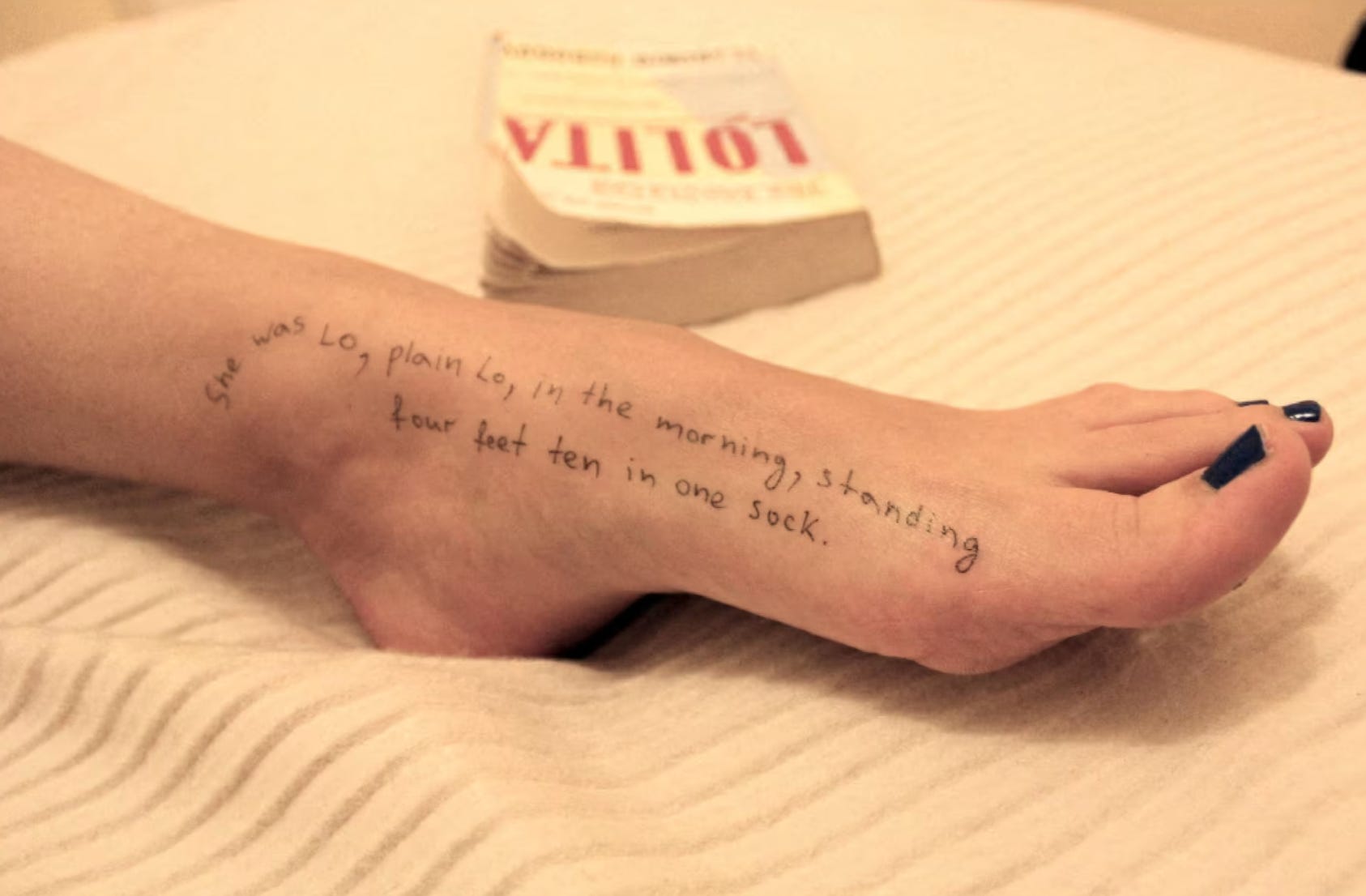
Figure 3. Lo and Behold
There are many questions one might ask when encountering a photograph like such: Why was this photograph taken? What purpose was it meant to serve amongst the Epstein crew? Should we — or, better yet, can we — take the Lolita reference as evidence of Epstein’s own pedophilia? Barthes, later in “The Photographic Message,” would write about the problem of interpreting an image in tandem with text, noting that the photograph is not an isolated structure, but exists in communication with the captions, titles, and language that surrounds it. He notes that these two structures are ultimately independent, and yet our modes of semiotic and linguistic interpretation become contiguous, impossible to separate. Yet Barthes was writing about the press photograph, whose text appears as a de facto addition to the photograph, serving as an intentional interpretative clue. In the Epstein photograph, however, the text is inscribed in the image — and better yet, on the body of its subject — as if to heavy-handedly suggest its very own interpretative frame. With a physical copy of the book conspicuously placed in the background of the image, the photograph exhibits an explicit allusory function, as if begging the reader to situate Epstein within the cultural notoriety of Lolita. Yet are we to interpret this as a direct evidentiary disclosure, or something more cunning, like Epstein’s knowing wink of his own evidentiary status — as if to say: try and catch me.
More than matters of the individual photograph, the Lolita plot provides a clear narrative hook by which we can attempt to cohere the archive as a whole, as if Epstein laid out a clue for us to connect the dots of his whereabouts. Perhaps it is too on the nose that his private jet was explicitly named the “Lolita Express.” In the wake of the image’s release, journalist Graeme Wood would follow the Lolita lede all throughout the Epstein Files, surfacing the 253 (!) mentions of the word “Lolita” spread throughout his documents. Lolita thus opens up new connections in the archive — correspondences between Epstein and Yale English professors, for instance — that serves to implicate a host of actors into his schemes. “One of the minor annoyances of being an incorrigible pervert,” Wood writes, “is that you risk having your own bookshelf testify against you.”
But there is, I think, also something more interesting at play. By overtly stylizing his own crimes, it could be said that Epstein is sowing a seed of doubt between “real” evidence, and his own staging of a suggestion of wrongdoing. As literary scholar Rhonda Garlick wrote in the New York Times about the Lolita image: “Is this an inside joke? And if so, who is the presumed audience? Or could this be an attempt to elevate a crime into an act of literary appreciation — trying to soft-pedal abuse by lending it the patina of a secret book club?” By cultivating his reputation as the aesthete and the intellectual, Epstein could lay his filth bare for everyone to see, as if his crimes could be spontaneously transfigured into an act of high culture. It would simply be too rich — too obvious — if the 60-year-old man obsessed with Lolita actually turned out to be a pedophile.
Upon sifting through the Epstein Library, I happened upon an image I had never seen before: a photograph taken inside 9 E 71st St, Epstein’s Manhattan residence (Figure 3). Unlike the two photos before — carefully composed, artful even — this photograph bears the markings of an investigative search: a tad overexposed, taken in the dark of the night, frantically framed as if to point at nothing in particular. I was first entranced, however, not by the pile of books that sit atop Epstein’s elaborate filing system, but the fact that the photo itself was taken inside a closet: a structure far too on the nose for a discovery of this sort. As critical theorist Eve Sedgwick argues, the closet functions epistemologically in contemporary culture, structuring the conditions under which one’s sexuality can be both visible and simultaneously ignored. The closet functions as an “open secret,” as Sedgwick terms it, producing an ignorance around what she calls the “imbecilically self-evident.” While Epstein is “closeted” in a far different sense than the homosexual of Sedgwick’s study, my point is that the structure of the open secret mirrors exactly the function of the evidentiary image circulated in the Epstein-era: images whose apparent obviousness both signals and yet simultaneously conceals secrets we’d prefer to ignore. It allows us to discount what is right in front of our eyes.
Figure 3. In the Closet
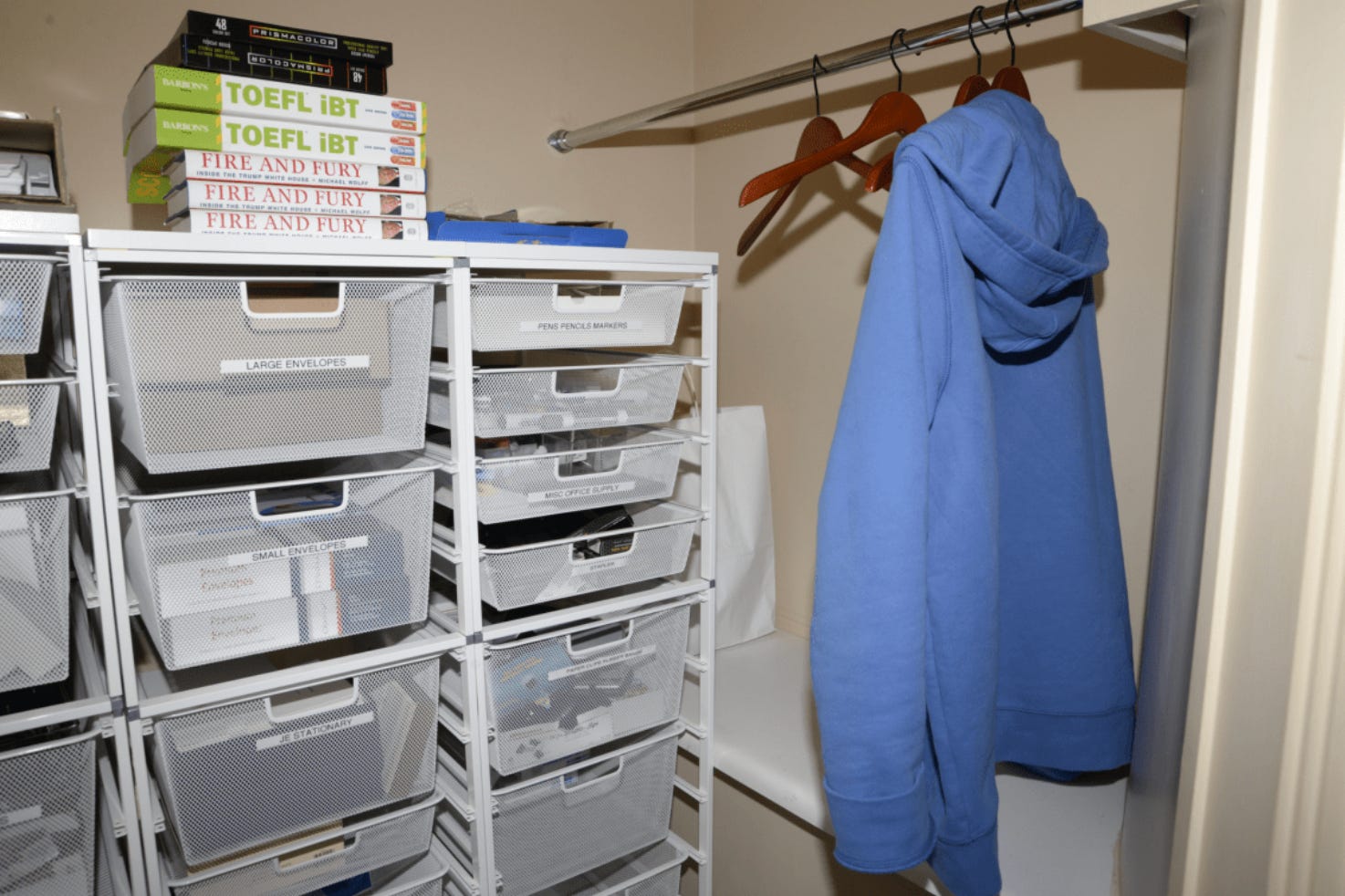
More concretely, I shall point your attention to the five books atop the filing cabinets: two TOEFL IBT Barron’s books, and three copies of journalist Michael Wolff’s Fire and Fury, a “gossipy” but nevertheless revelatory account of Donald Trump’s 2016 presidential campaign. On an evidentiary level, of course, the photograph seemingly discloses nothing: it merely appears that he is stocking away a part of his book collection. The irony of the photograph screams out, however, when we begin to question why Epstein — a 66-year-old Brooklyn-born US citizen — has numerous copies of TOEFL books: study guides designed for the English literacy exam for non-native speakers. The conspiratorially inclined might interpret these books in light of recent testimony that Epstein would often purchase TOEFL books for his victims, encouraging them to enroll in college in an effort to obtain a visa. Maintaining a public interest in the “literacy” of young women — donating millions of dollars to Harvard, MIT, and Columbia — Epstein’s “image” as the intellectual-philanthropist thus served to conceal a much darker truth. Here, the book acts as a semiotic misdirect — providing an innocuous veneer beneath which he could proceed, undetected.
Taking this into account with the fact that Epstein has numerous copies of Michael Wolff’s Fire and Fury — the author who, not-so-coincidentally, was slated to be Epstein’s biographer — Epstein appears obsessed with the image and circulation of his literariness, his own star-status within a book of his own. Yet, with over five books published about Epstein in the last five years alone — and over 3.5 million documents contained within his very own criminal archive — Epstein can rest assured that he finally has a library of sorts named in his honor.