Clanging
everyone's scaredy and stuck

All writing is garbage. People who come out of nowhere to try and put into words any part of what goes on in their minds are pigs
Antonin Artaud, The Nerve Meter (1925)
In 2025, the artist Emily Allan released her debut concept album, Clanging. The album borrows its title from an outdated psychiatric term, the symptom wherein one — typically a schizophrenic or bipolar patient — begins to spontaneously rhyme, finding their speech stuck on certain phonetic associations across language. As the phenomenon is evoked on Allan’s album, it takes on the quality of an aggressive alliteration, as in her final track, “Everybody’s Wife:”
Everyone’s scared to be sucked
Everyone’s carefully cucked
Everyone’s fucked
Everyone’s scaredy and stuck
Everyone barely got up when I came out the muck.
Situated somewhere between drivel and rap, how one discerns the precise pathology of “clanging” is, of course, suspect. As opposed to a random ordering of words, clanging indeed maintains a formal logic to its structure, as evidenced by Allan’s repetitive “everybody” and her consonant fixation on the “uck.” Yet, when the poet or artist rhymes, this is decidedly not a case of clanging. Speech qualifies as clanging only “if you’re someone who’s not supposed to be rhyming,” as Allan clarifies in a 2025 interview with Document Journal, when language is deemed not born of one’s natural state, but rather a symptom of one’s underlying madness or compulsion.
One cannot discuss clanging without encountering the problem of one’s so-called “natural” structure of speech. The paradox of clanging and Clanging (the album) is that it is exploration of disordered speech that recuperates the illness as something akin to an artistic style. Far from a complete breakdown of language, clanging is an obsession with language — a glossomania. As one music journalist wrote of the album, clanging is “un-free association, a space where the poetic resonance of rhyme grows from a funny coincidence into gospel.” It is a hyperfixation on the strangeness of the vocabularies to which we have found ourselves bound, the words and semantic structures that we have assimilated without question. Allan herself states that the album was produced out of “jealousy” for those who could access such intense states of riff, writing that “there’s so much freedom in that writing, there’s so much saying shit that you can’t really say, things outside of the social contract.” Her fascination lies in how the expressive capabilities of disordered speech often exceed those afforded to us within the confines of semantic coherence.
It would be a fallacy to attribute such artistic inquiries to Allan, however, as they have long been at the core of the avant-garde. It is perhaps impossible to discuss the aesthetics of madness without glossing over the works of Antonin Artaud, famed madman, poet, and theater-maker. After being diagnosed with schizophrenia in 1939, Artaud would write that the “authentic madman” is a man who “preferred to become mad,” rather than “forfeit a certain superior idea of human honor.” Viewing his diagnosis as the engine of his artistic production, he would spend the years leading up to his institutionalization writing The Theater and its Double, a manifesto wherein he disavowed theater in its entirety, proposing instead the “Theater of Cruelty.” The Theater of Cruelty does away with the semantic meaning of the written word, favoring instead the “spectacle of sonorisation,” wherein “sounds noises, cries are chosen first for their vibratory quality, then for what their represent.” Rather than language being employed to represent reality, language was used to disrupt what he deemed the “exhaustion” of expression, breaking language apart in order to “start anew and begin fresh” (74). What this would amount to, in practice, was Artaud shrieking and screaming on stage, engaging in rhythmic expulsions of his inner turmoil. Art, as Artaud saw it, could only surface once language transformed from a tool of meaning-making to an element of sensorial shock.
Both Allan and Artaud are concerned with a sort of liberatory personality that emerges once one breaks from the conventions of sensible or ordinary language. I have decided to pair these two together, however, insofar as both artists ultimately stop short in their investigations. The question that remains, at least to me, is what we can actually consider to be a language. And why limit ourselves to verbal language? If language, as they conceive of it, refers only in the structure of the written or spoken word, then how might we contend with a language of the visual order? In the case of the Theater of Cruelty, Artaud is implicitly grappling not just with the spoken language of theater, but also a gestural and bodily one. In The Theater and its Double, he calls for an “intensive mobilization of objects, gestures, and signs,” writing that “words say little to the mind; extent and objects speak; new images speak” (87) The image, in Artaudian logic, is a complex concept. Referring less to the photographic image and more to a unity of gestures and “mysterious signs,” Artaud ultimately favored the image over the word as a way of harnessing “some unknown, fabulous, and obscure reality,” which he claims that Western culture has “repressed.” The image, in this sense, was able to shock the mind out of its tried and true patterns, allowing the formation of alternate imaginaries.
Artaud lauds the image as something capable of transcending the rules of language composition. Yet, does not the image itself operate within the confines of a semiotic language, with the same oppressive capabilities of the word? While Artaud viewed the “image” as an object free from the chains of conventional composition, the image, as we conceive of it today, surely rests within a matrix of visual iconography. And even more than this — if we are to accept the famous proclamation that film is structured “like a language,” the syntactic as well as semantic capabilities of cinematic structure begin to abound. How, then, might a mental processing disorder such as clanging — along with its compulsion to rhyme, its intense repetitions — manifest in the visual order?
To this, I turn to one final practitioner in our trio of alliterative artists: the experimental filmmaker Martin Arnold. In 1993, Arnold would release Passage A L’Acte, an 12-minute short film composed of found footage from Robert Mulligan’s 1963 adaptation of To Kill a Mockingbird. His chosen scene is a domestic tableau, featuring the quintessential Finch family gathering around their kitchen table for a meal. Within seconds, however, the viewer is clued in on the film’s particular affliction: the scene starts and stops in fits, finding itself stuttering over certain images, as if there is a skip in its proverbial record player. Yet the tic does not resonate on a merely technical level; each member of the Finch family is overcome by this mysterious illness, their bodies rapidly convulsing.
Figure 1. The Finch Family
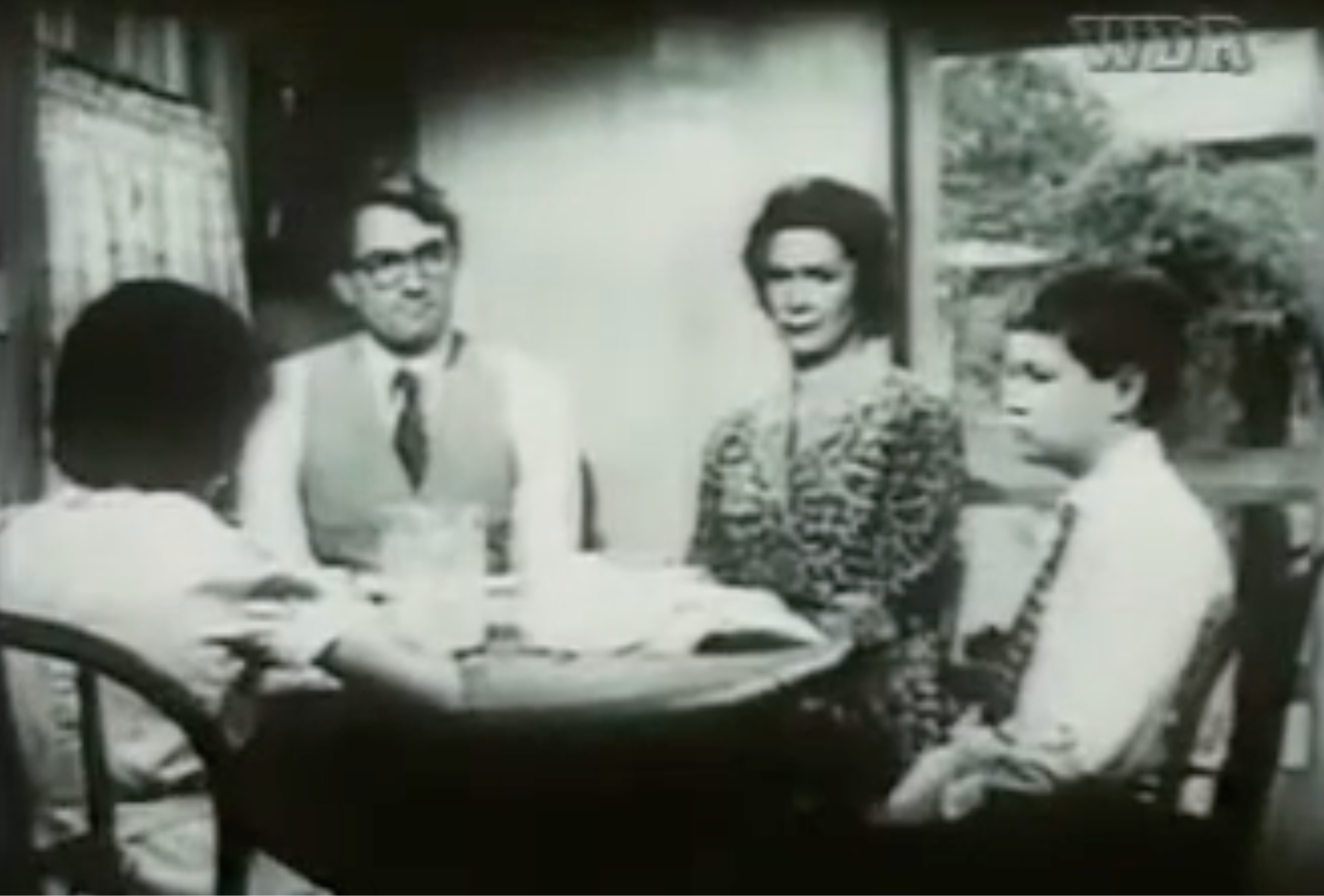
Commenting on Passage A L’Acte, the critic Akira Mizuta Lippit writes that “the projector’s systemic dysfunction affects—or rather infects—the diegetic characters with a kind of rhizomatic virus, transmitted from apparatus to subject.” While I agree with this sentiment on a technical level — the projector is indeed causing the characters to appear warped in this way — when watching the film, the viewer sees this phenomenon in reverse: it appears as if the illness borne of the characters has invaded the image, that the image has become imbued with the human quality of the schizophrenic. Schizophrenics, in particular, maintain a dysfunctional relationship to visual illusion. As a 2017 psychiatric study found, those with schizophrenia are “mostly immune to the effects of high-level illusory displays,” meaning that they cannot understand the image as a representation of reality. In this standard sequence of To Kill a Mockingbird, for instance, one must register the figure of the mother, the father, the daughter, and the son in order to cohere the image and the plot of the movie as a whole. The kitchen of this film is grouped among the kitchens of cinematic memory, its sense derived from the experience of the viewer. The schizophrenic, however, ingests the image as “raw sensory data.” The image is interpreted literally — as a collection of colors, shades, and shapes — as opposed to specific objects, people, or references. On a filmic level, the repetition of shots, cuts, and in-frame gestures become less a tool of narrative cohesion, and more of rhythmic delight.
Passage A L’Acte succeeds as a clanging object, in that it disrupts the sovereign order of the classic Hollywood image. It is not merely an experimental film for the sake of being experimental, but rather it burrows itself inside of the ostensibly “universal” language of cinema. In one segment of the film, little Scout Finch is implored by her eager brother, Jem, to “hurry up” so the two can finish their food and proceed in their playing outdoors. Seemingly unable to control the spasms of her body, however, Scout tries to sound out the phrase “I’m trying.” The visual pun here is that just as the diegetic Scout herself “tries” to speed up, the film itself is stuck in its own “trying,” unable to get past its consonant “tr” as the camera swivels back and forth from sibling to sibling. Yet it is in this disjunction of cinematic form that the actual contents of the film’s structure spill out, making themself garishly present. When we typically watch a film, we pay little conscious attention to the patterning of shots (unless, perhaps, your name is Raymond Bellour). Passage A L’Acte’s incessant clanging on the dual close-ups of Scout and Jem Finch, however, seems to unearth an aggression of this cut from brother to sister, as if to suggest the madness that it latent in all cinematic structures. Critic Scott MacDonald argues that this maneuver is like a repressed symptom coming to light, writing that “behind the intact world being represented, another not-at-all intact world is lurking.” Especially in the case of To Kill a Mockingbird — whose entire premise rests on the threat of a figure looming in the distance, Passage A L’Acte makes clear the paranoia of the domicile, though often considered the safe zone in filmic territory. Clanging acts as a “revenge on film history,” Macdonald writes, surfacing hidden affects that are often excluded from the coherent image of classic cinema.
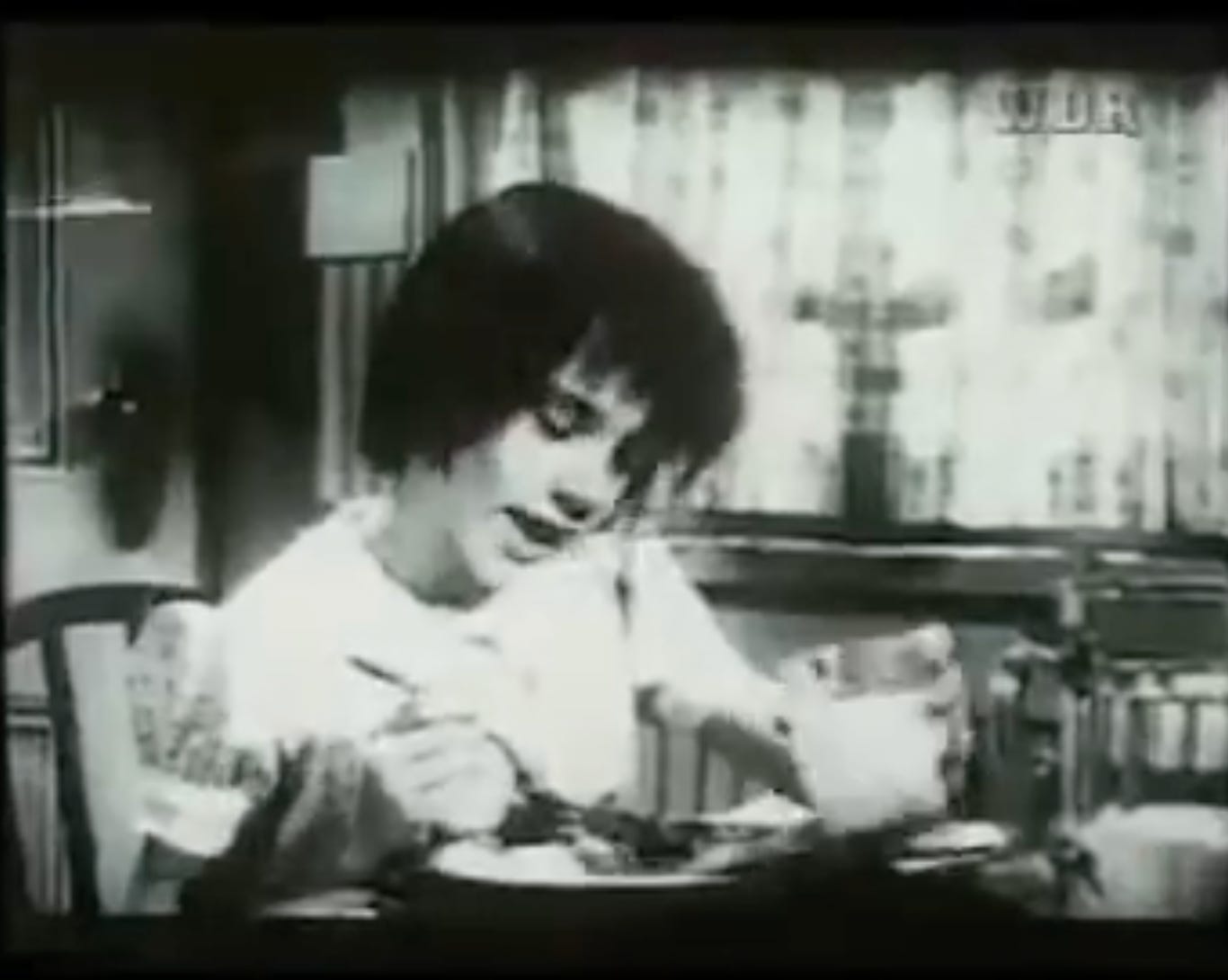
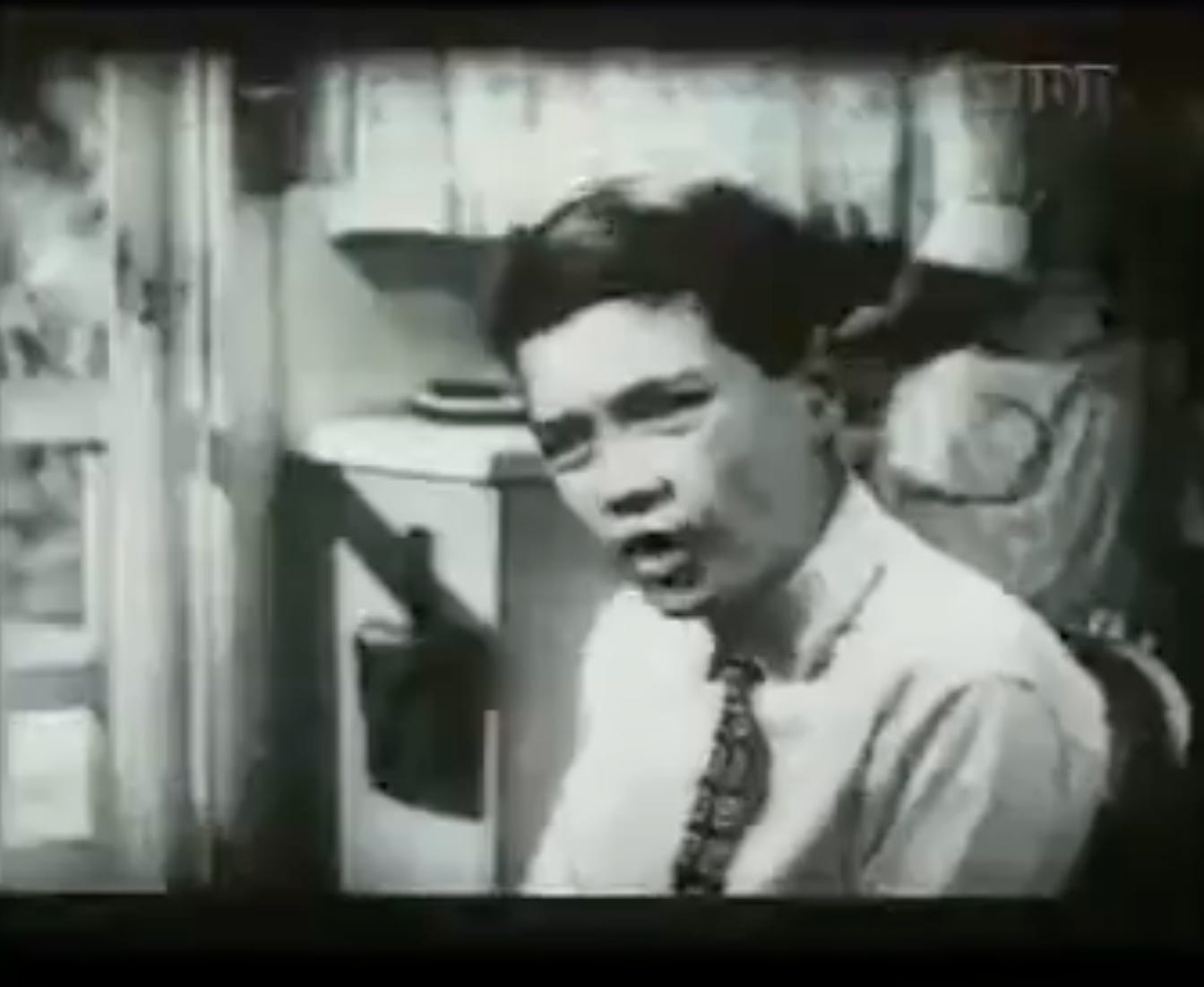
Figure 2. Scout and Jem
Passage A L’Acte roughly translates to “acting out” in English — the phrase commonly used to describe the tantrums of a small child or, in the case of psychology, the violent physical aggressions that manifest as a result of one’s inner emotional turmoil. Martin’s invocation of mental disorders is thus a highly intentional one. As he writes in an interview with Macdonald:
Through the acquisition of language, our entrance into symbolic order and thus into societal order is accomplished. And there is no escape from language (or society) except for becoming mad. This holds true for us as well as for the protagonists of Passage a l’acte, though they are evidently treated worse: they are not only victims of the order of family, society, and language, they are also victims of the order of Hollywood cinema, and in my hands, of independent cinema as well.
Macdonald thus views the clanging of his film as a way for the characters to break not just from the linguistic order of their speech, but of the semiotics of the standard image. His last point, however, is a fascinating one: while independent cinema — including Martin Arnold’s own film — seek to remove themselves from the codes of Hollywood cinema, a film can never truly escape, as they are still operating within the standard language of the cut, the shot, the image. Even if one has gone “mad” — even if the film starts and stops in fits — they are still, in the end, operating in the same vernacular as the “normal” man. It is here that we encounter a crisis of originality: an inability to speak for oneself, a realization that all language is, in fact, foreign, borrowed, alien to the individual.
What clanging — and Allan, Artaud, and Arnold — teaches us is that even madness contains traces of the logical; that the breakdown of language is often more coherent than its sovereign form. Yet there is also a more subtle, counterintuitive takeaway implicit within this: that language is itself bordering on the mad; that expressing oneself at all is always a tenacious act.